Know which sound to fix.

Spanish, German, French, Italian, Brazilian Portuguese, Swedish, and American and British English.

A pronunciation coach for people who already speak the language. Say a word, see a score for each sound, and learn how to fix the weakest one.

  • No account
  • Works offline
  • Scored on your phone
  • iOS 26 or Android 12

One take, two answers

Language apps say “Great job!” Shablau shows which sound to change.

A learner reads “Please do not think that I already know it all.” Here is what each app says.

A language app

Great job!

The sentence counts as right. You never learn which sounds to fix.

Shablau

The lines show how the voice goes up and down. Blue band: a native speaker. Dark line: you. Red: a sound to change.
  1. Please

    • P84
    • l100
    • ea94
    • se100
  2. do

    • d100
    • o96
  3. not

    • n100
    • o93
    • t85
  4. think

    • th18sounded like t
    • i100
    • n100
    • k100
  5. that

    • th24sounded like d
    • a89
    • t94
  6. I

    • I88
  7. already

    • al95
    • r96
    • ea88
    • d93
    • y85
  8. know

    • kn100
    • ow100
  9. it

    • i100
    • t92
  10. all

    • a84
    • ll41sounded like u

Tap a word to see its sound scores.

  1. thinkYou said “tink”

    Put the tip of your tongue between your teeth. Blow air out softly, with no voice.

    Practice: thin, thank, three

  2. thatYou said “dat”

    Put your tongue between your teeth, the same as in think. This time use your voice, so your tongue buzzes.

    Practice: this, they, mother

  3. allYou said “au”

    Touch the bump behind your top teeth with the tip of your tongue. Hold it there until the word ends.

    Practice: ball, tell, feel

You
A native speaker

The lines come from the two recordings. The marks are an example: the app scores one word at a time.

Pronunciation coaches that score each sound are English-only and keep your recordings on their servers. Shablau scores your voice on your phone, in eight languages, and never sends your recordings anywhere.

How it works

Listen, say it, change one sound.

The word kaffe (coffee), with example scores and the app's own tip.

  1. 1Hear a native speaker say it.
  2. 2Say it. Each sound gets a score from 0 to 100.
  3. 3Fix the marked sound. Reach 80 and the app says Shablau!

kaffe

coffee

First try

  • k100
  • a38
  • ff92
  • e100

What to change a · 38

Your a was long and at the back of the mouth, as in “tak”. In “kaffe” the a is short and at the front, followed by a long consonant.

Again

3 of 4 right · the a sets the score

Second try

  • k100
  • a97
  • ff100
  • e100

Sounds

  • k100right
  • a97right
  • ff100right
  • e100right

Shablau!

First pass on this word

Two tries at the word kaffe. First try: k 100, a 38, ff 92, e 100. The a is marked, and the app says Again: 3 of 4 right, the a sets the score. Second try: k 100, a 97, ff 100, e 100, and the app says Shablau!

How to make the sound

See where your tongue goes.

When a sound scores low, Shablau draws your mouth from the side and your lips from the front. A dashed line shows the tongue for the sound Shablau heard you say. Pick a word.

English

think

to think

Lips for th
  • Tongue tip between the teeth.
  • Leave a narrow gap for the air.

Spanish

mujer

woman

Lips for j
  • Back of the tongue up against the soft palate.
  • Leave a narrow gap for the air.

French

rue

street

Often said: ou
Aim for u
  • Move the tongue further forward.
  • Keep the lips as for ou.

Italian

gnocchi

potato dumplings

Lips for gn
  • Middle of the tongue up against the hard palate.
  • Air goes out through the nose.

German

schön

beautiful

Often said: e
Aim for ö
  • Keep the tongue as for e.
  • Round your lips and push them forward.

Portuguese

pão

bread

Lips for ão
  • Tongue low, in the middle.
  • Lips spread.
  • Air goes out through the nose too.

Swedish

cykel

bicycle

Often said: i
Aim for y
  • Keep the tongue as for i.
  • Round your lips and push them forward.

Accents

Pick the accent you want.

Pick a region, and Shablau compares you with people who grew up there.
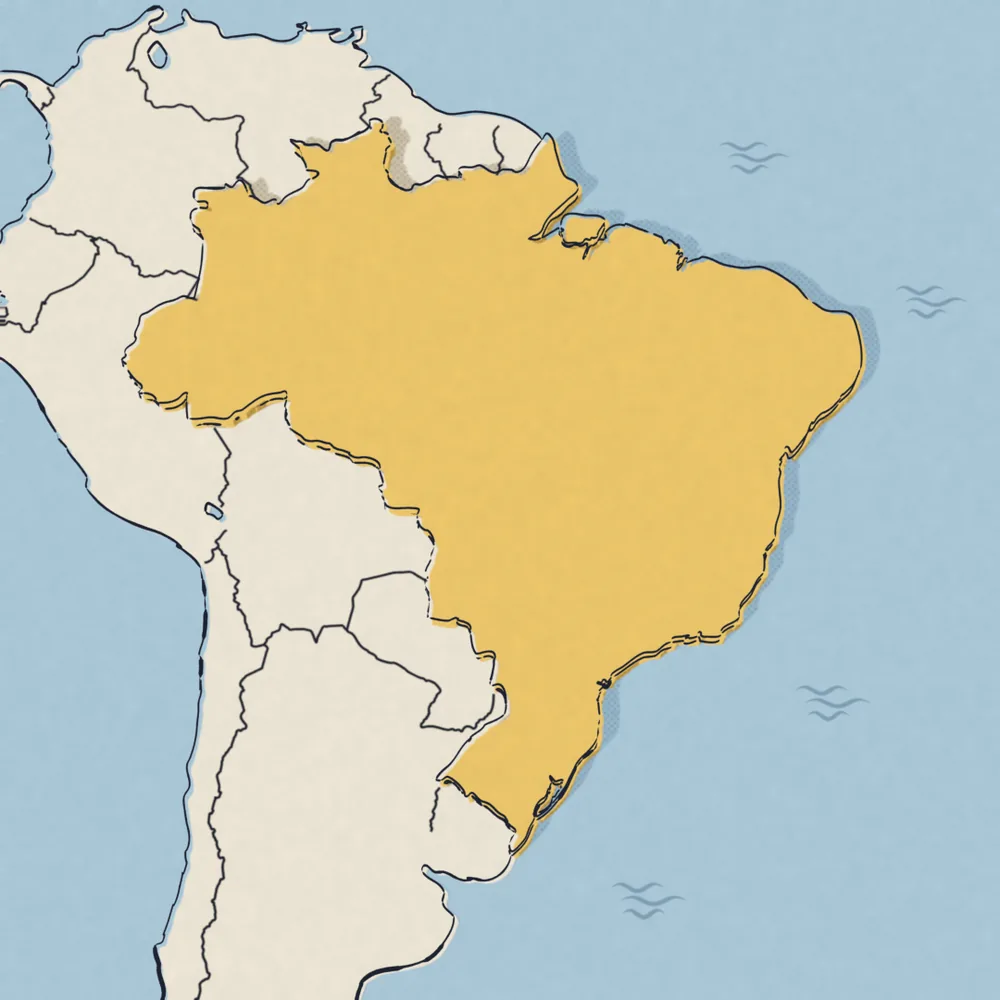
Accent map (Brazil): General Brazilian, São Paulo, Rio de Janeiro, The North-East, The South.
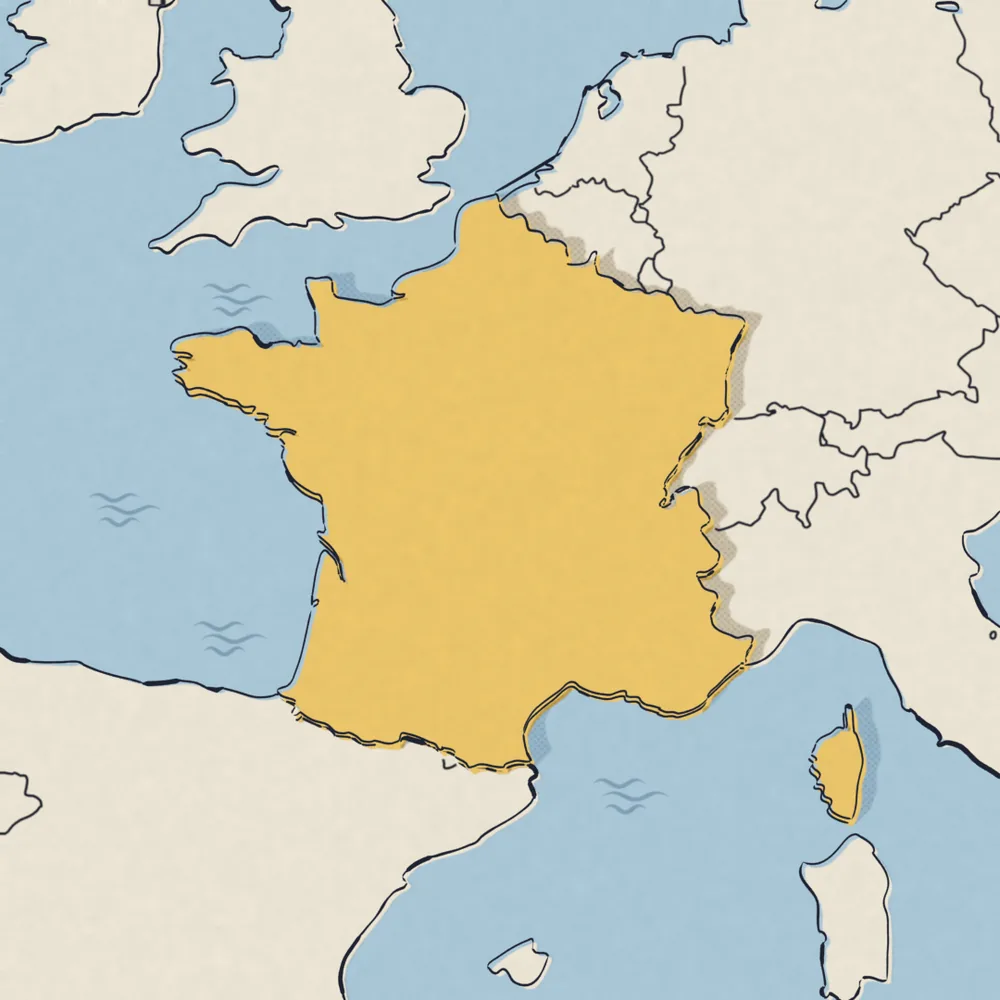
Accent map (France): Every French region.
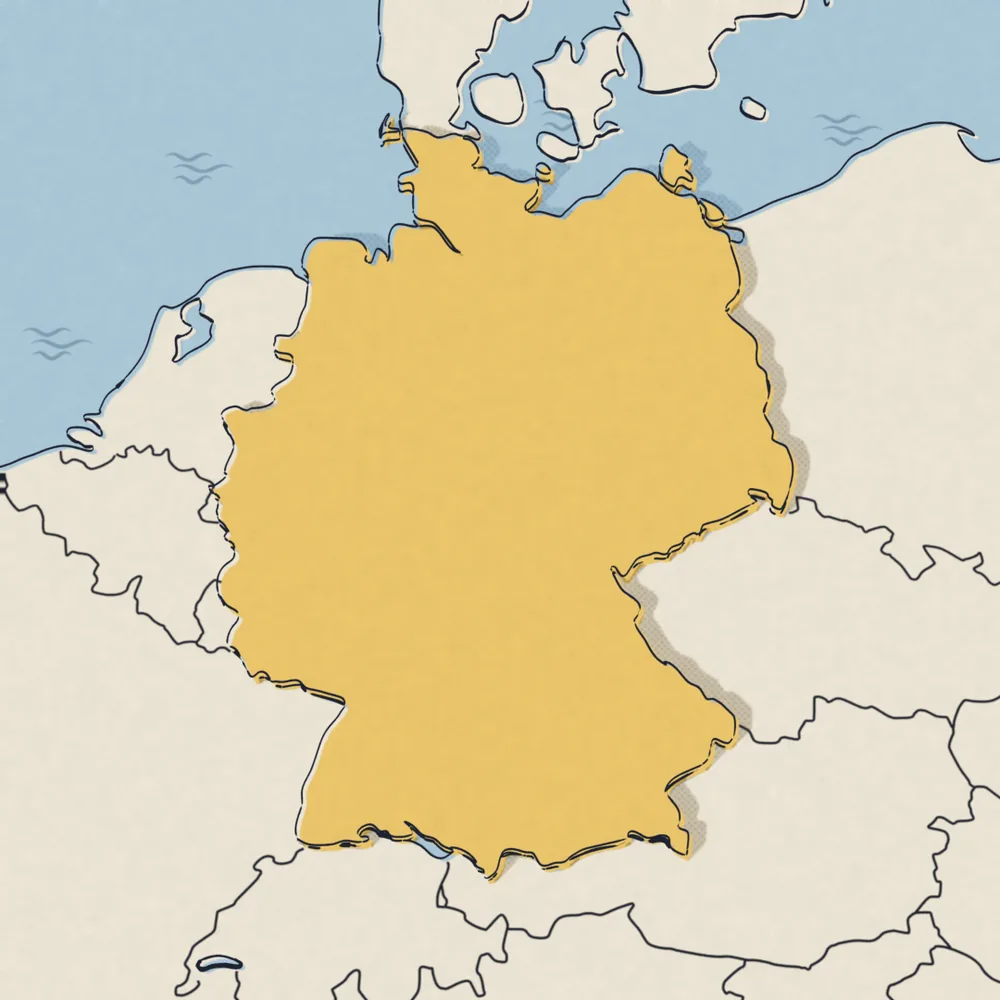
Accent map (Germany): Standard German, Berlin, Bavaria, Hamburg, Saxony, Swabia.
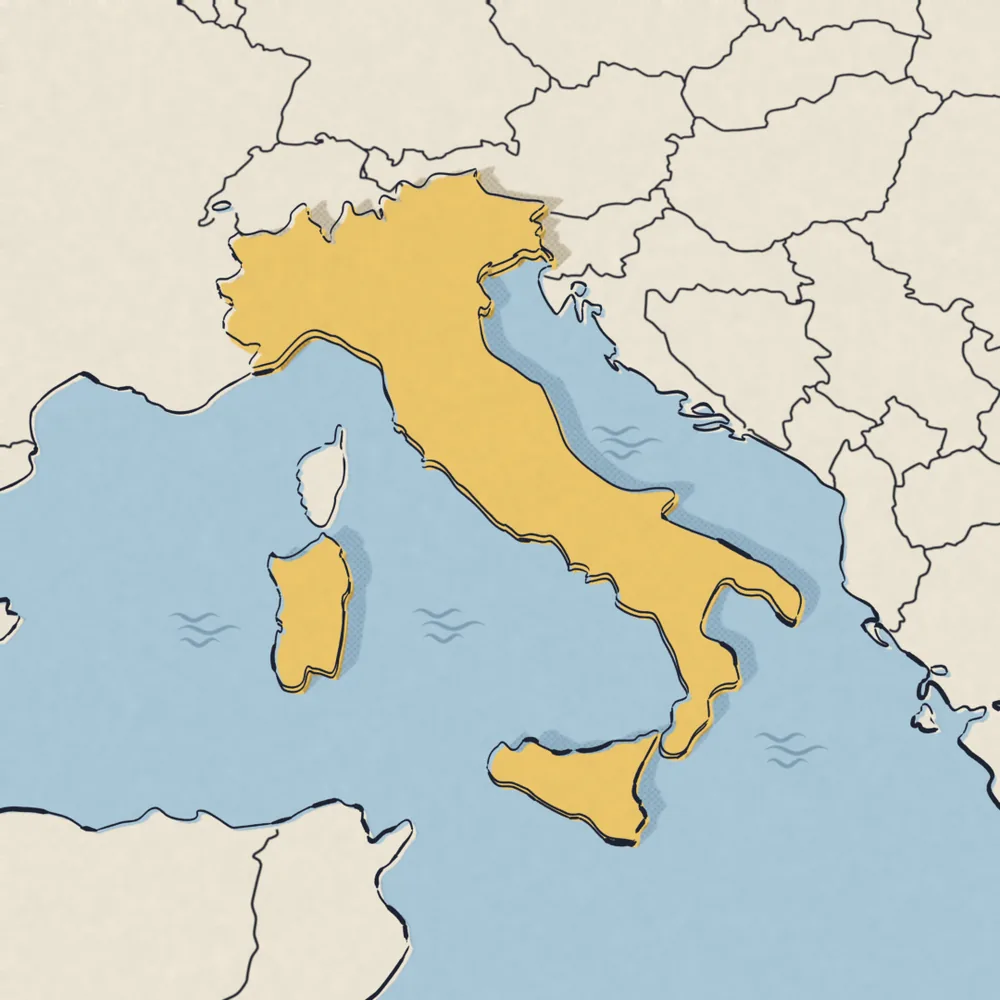
Accent map (Italy): Every Italian region.
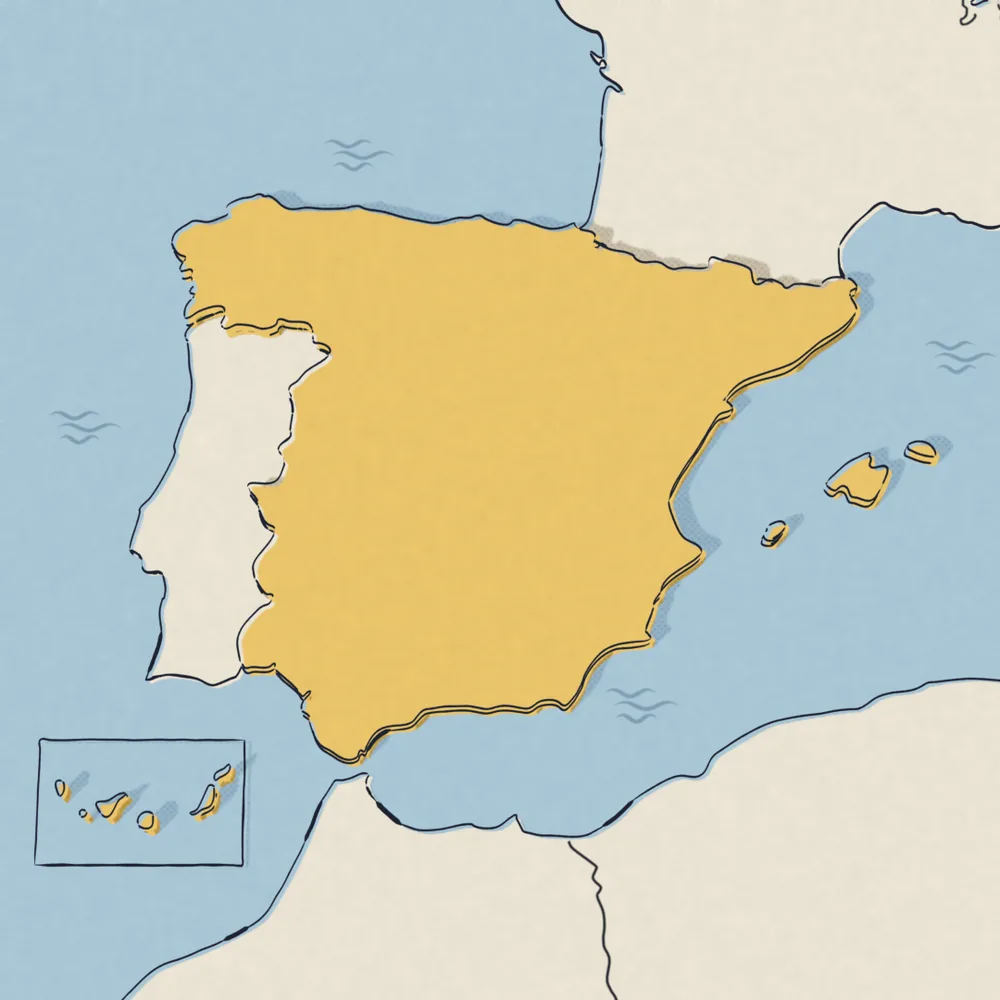
Accent map (Spain): Central Spain, Andalusia, The Canary Islands, Galicia, Catalonia.
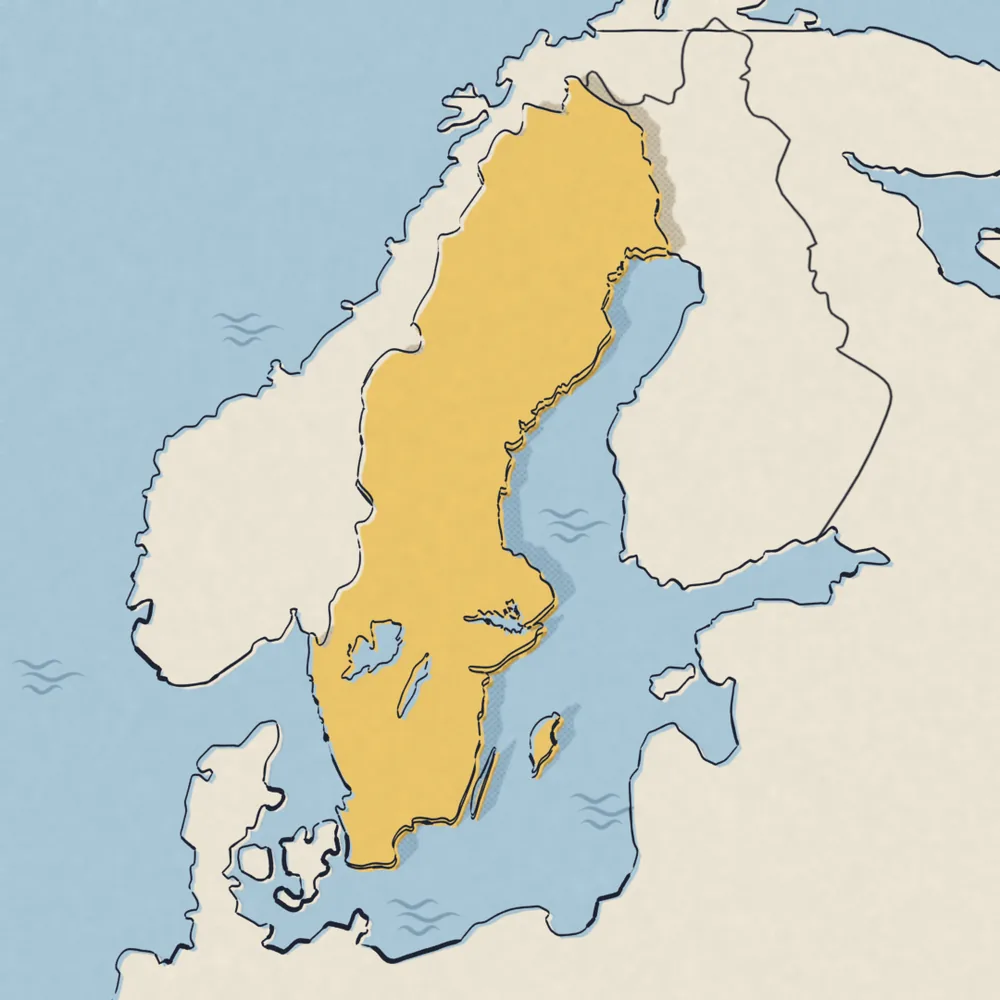
Accent map (Sweden): Stockholm, Skåne, Göteborg, Norrland, Gotland, Finland Swedish.
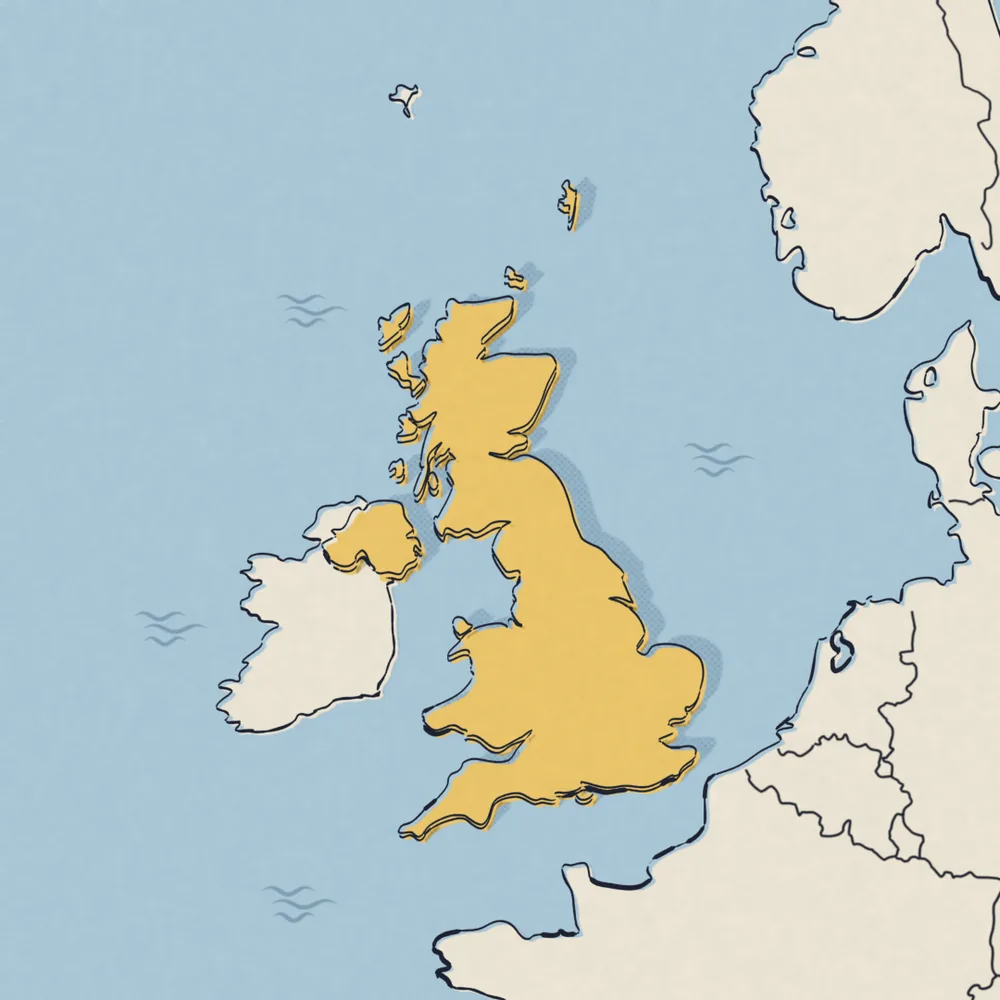
Accent map (United Kingdom): Standard Southern British.
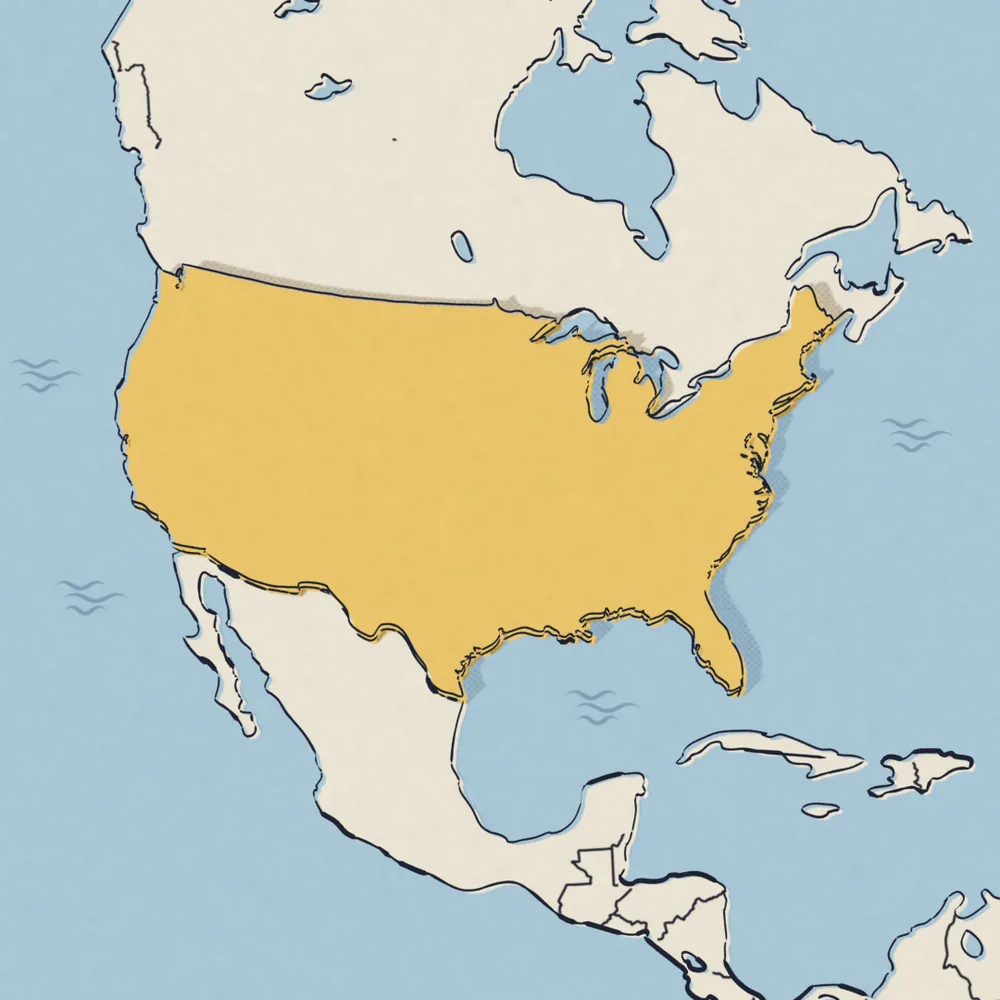
Accent map (United States): General American, Appalachia, The South, New York, Boston.

Brazil

  • General Brazilian
  • São Paulo
  • Rio de Janeiro
  • The North-East
  • The South

France

  • Every French region

Germany

  • Standard German
  • Berlin
  • Bavaria
  • Hamburg
  • Saxony
  • Swabia

Italy

  • Every Italian region

Spain

  • Central Spain
  • Andalusia
  • The Canary Islands
  • Galicia
  • Catalonia

Sweden

  • Stockholm
  • Skåne
  • Göteborg
  • Norrland
  • Gotland
  • Finland Swedish

United Kingdom

  • Standard Southern British

United States

  • General American
  • Appalachia
  • The South
  • New York
  • Boston

When you pass

From Again to Shablau!

Pass a word and the app says Shablau! A word you miss comes back later in the round and on other days, until you pass it every time. Three kinds of pass also get confetti and a badge. Here is one word, mujer:
  1. Today

    Again

    64, under 80, the score a word needs to pass. The word comes back later in the round.

  2. Later in the round

    Shablau!

    First pass. 83, over 80 for the first time.

  3. Another day

    Shablau!

    New best. 88 beats your 83.

  4. A third day

    Shablau!

    Word learned. Passed on 3 different days.
No streaks, no timers.

You remember a word longer when you practice it on different days than when you try it many times in a row. Read the research from Atomic Reps, the company behind Shablau.

The sounds that matter

Tak or tack? One vowel makes the difference.

Tak means roof, tack means thanks. Shablau checks whether your vowel was long or short.

tak

roof

This a lasts 0.31 seconds.

A long a, at the back

Open your mouth, pull your tongue back and round your lips a little. Hold the sound.

tack

thanks

This a lasts 0.09 seconds.

A short a, at the front

Keep the a short and open. Then hold the k a little longer.

More sounds you practice

  • sjuthe sj sound
  • tjugothe tj sound
  • musthe long u
  • fyrathe y: say “ee” with round lips
  • björnthe ö before r

The app

What you see in the app.

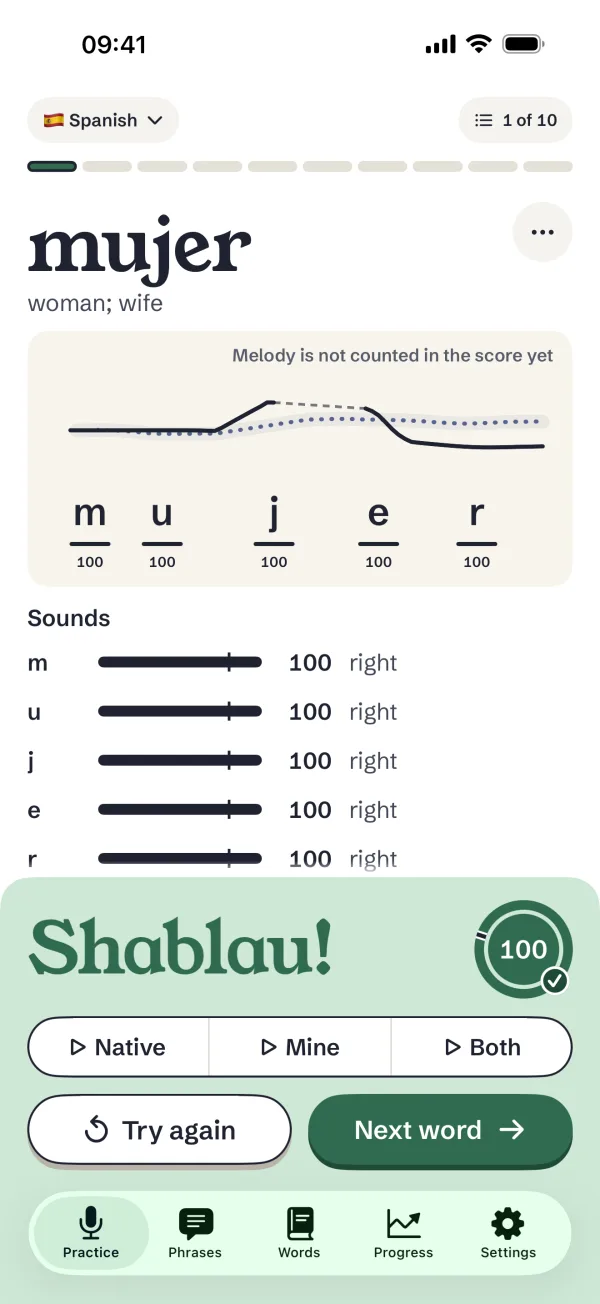
The Practice tab for the Spanish word mujer (woman; wife). Every sound scores 100: m, u, j, e, r. The green panel says Shablau! with a score of 100, and the buttons Native, Mine, Both, Try again and Next word.

Say a word, see each sound.

Hear a native speaker, say the word, and get a score from 0 to 100 for each sound.
  • The lowest sound sets the score, and the app marks it. A written tip says how to make that sound.
  • When a sound was close to another one, the app says so: “Sounded like …”.
  • Native, Mine and Both play the native speaker, your recording, or one after the other.
  • “Which word?” plays one of two words that differ in one sound, and you tap the one you heard. You need no microphone.
  • “Say it first” shows only the meaning of a word you have practiced before: say the word from memory, then hear a native speaker. You switch it on in Settings.
  • Words you find hard come back more often.
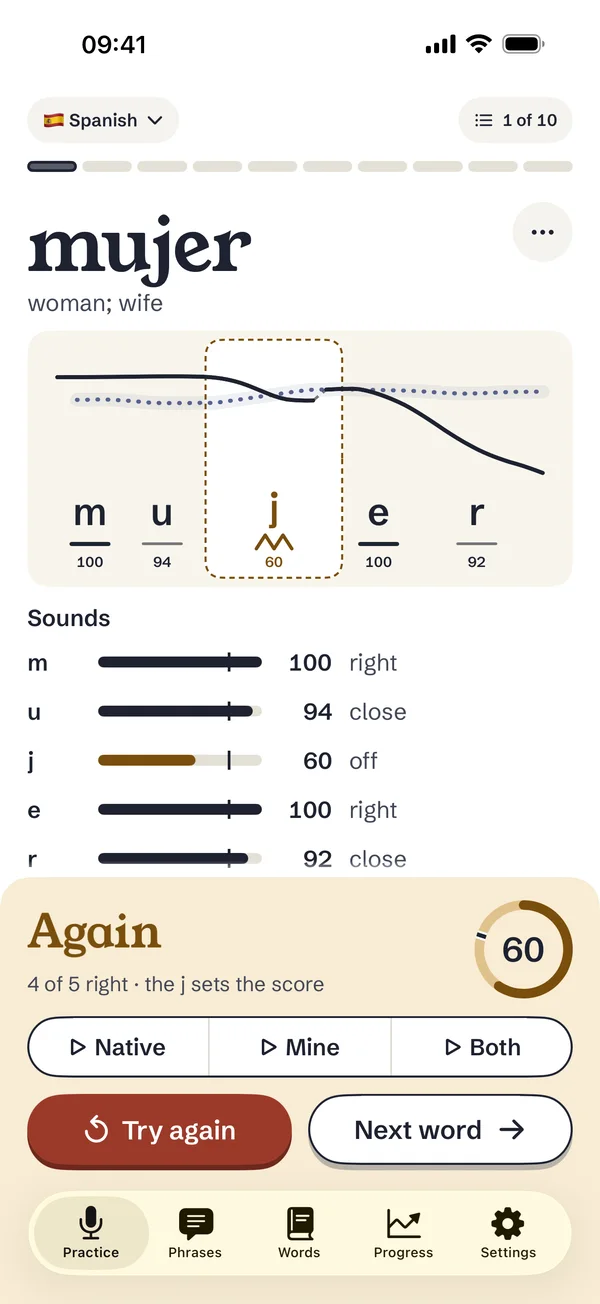
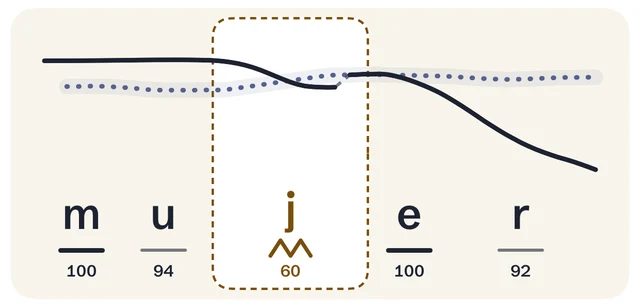
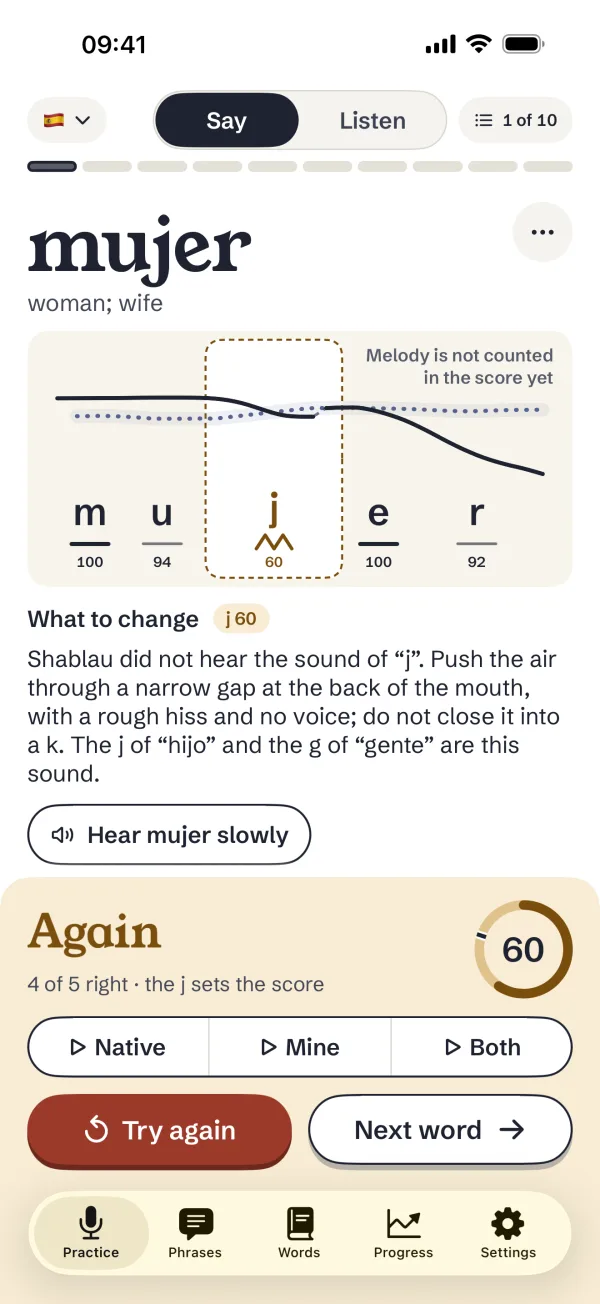
  • The Spanish word mujer after a take: the j scores 60 and is marked. Under What to change: Shablau did not hear the sound of j. Push the air through a narrow gap at the back of the mouth, with a rough hiss and no voice; do not close it into a k. The panel says Again, 60.

    What to change: the j of Spanish mujer.
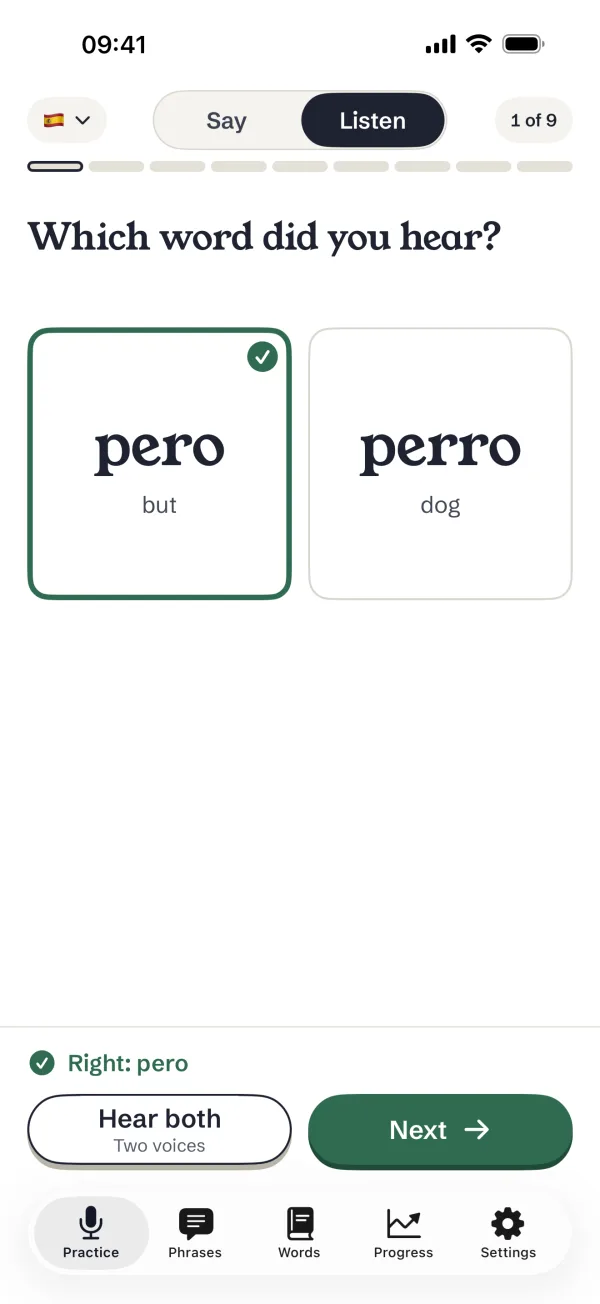
  • The Practice tab in Listen mode, in Spanish: Which word did you hear? Two cards, pero (but) and perro (dog). The pero card has a green check, and the panel says Right: pero, with the buttons Hear both and Next.

    Which word? Spanish pero (but) or perro (dog).
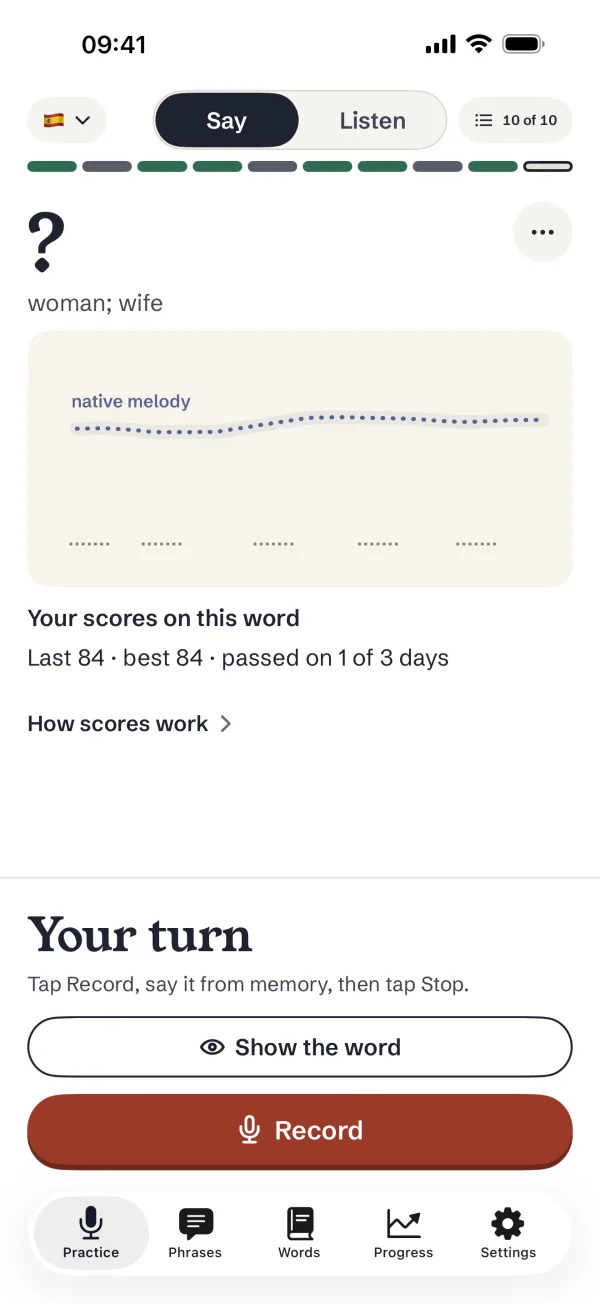
  • Say it first in Spanish: a question mark in place of the word, the meaning woman; wife, the native melody without letters, and the panel: Your turn. Tap Record, say it from memory, then tap Stop. The buttons Show the word and Record.

    Say it first: the meaning of Spanish mujer, with the word hidden.
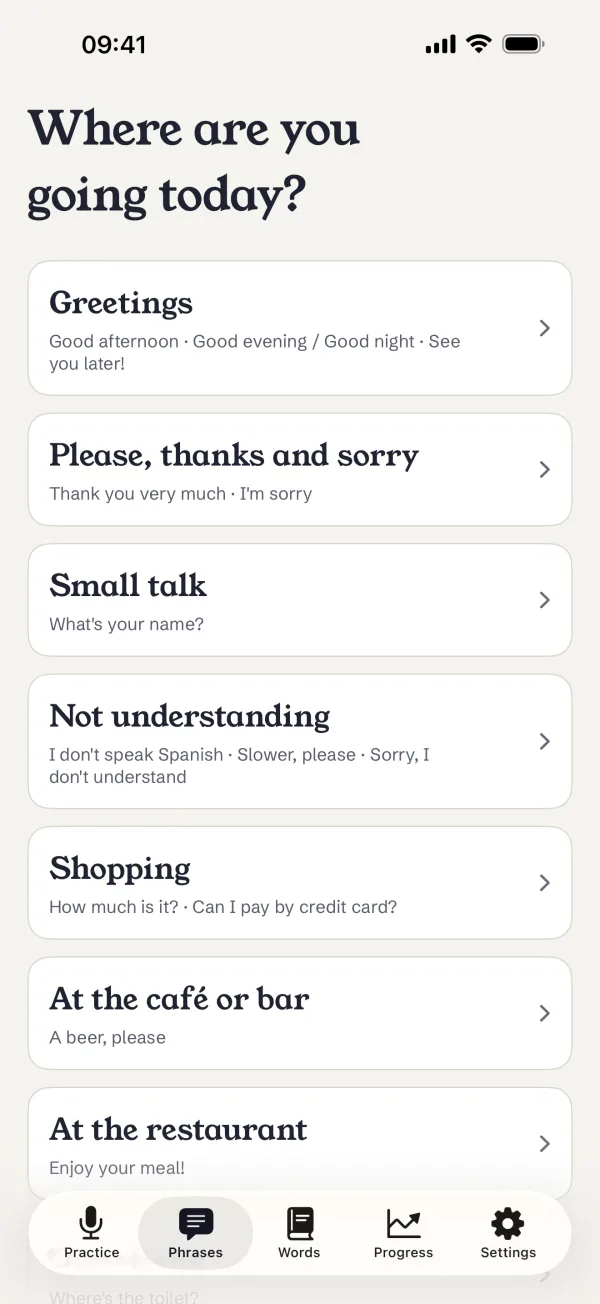
The Phrases tab for Spanish: Where are you going today? Situations with example phrases: Greetings, Please, thanks and sorry, Small talk, Not understanding, Shopping, At the café or bar, At the restaurant.

Where are you going today?

Pick a situation and practice the phrases you need there.
  • Situations such as Greetings, At the café or bar, Directions and Not understanding.
  • You practice a situation as a round, and each phrase gets a score for each sound, as a word does.
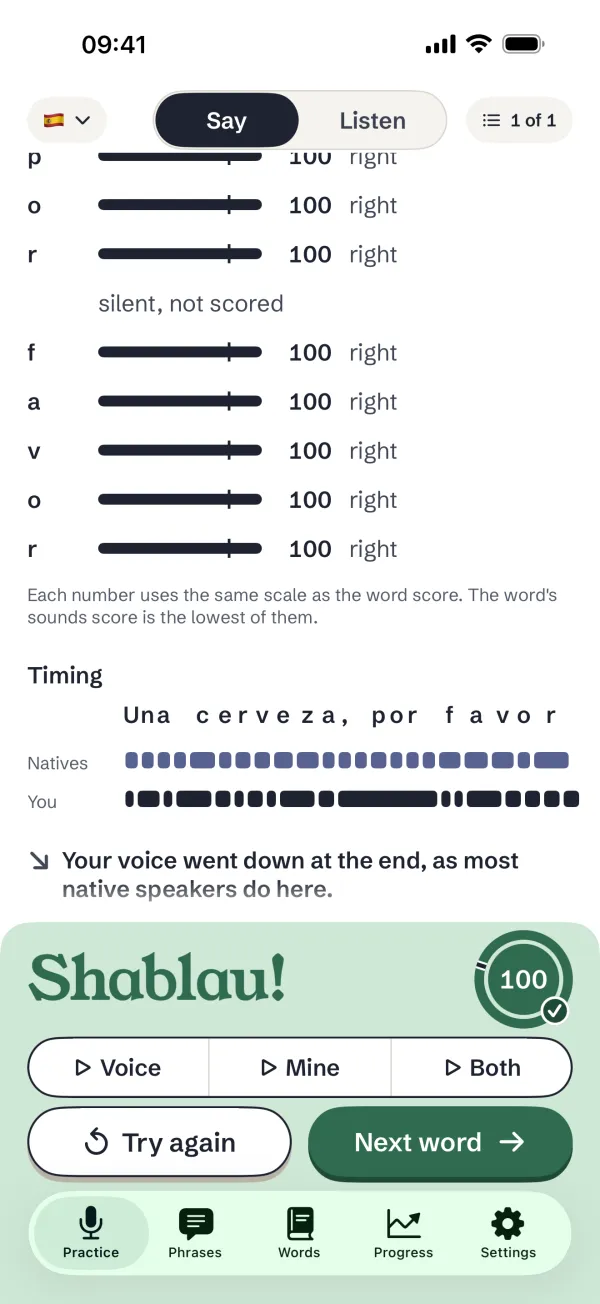
  • On some phrases in Spanish, French, Italian and American English, a sentence says whether your voice went up or down at the end, and how most native speakers end that phrase. The sentence does not change your score.
  • Phrases are in Spanish, German, French, Italian, Swedish, and American and British English.
  • The Spanish phrase Una cerveza, por favor after a recording that scores 100: a score for each sound, the timing of the native speakers and of the recording, and the sentence: Your voice went down at the end, as most native speakers do here.

    The end of Spanish Una cerveza, por favor (A beer, please).
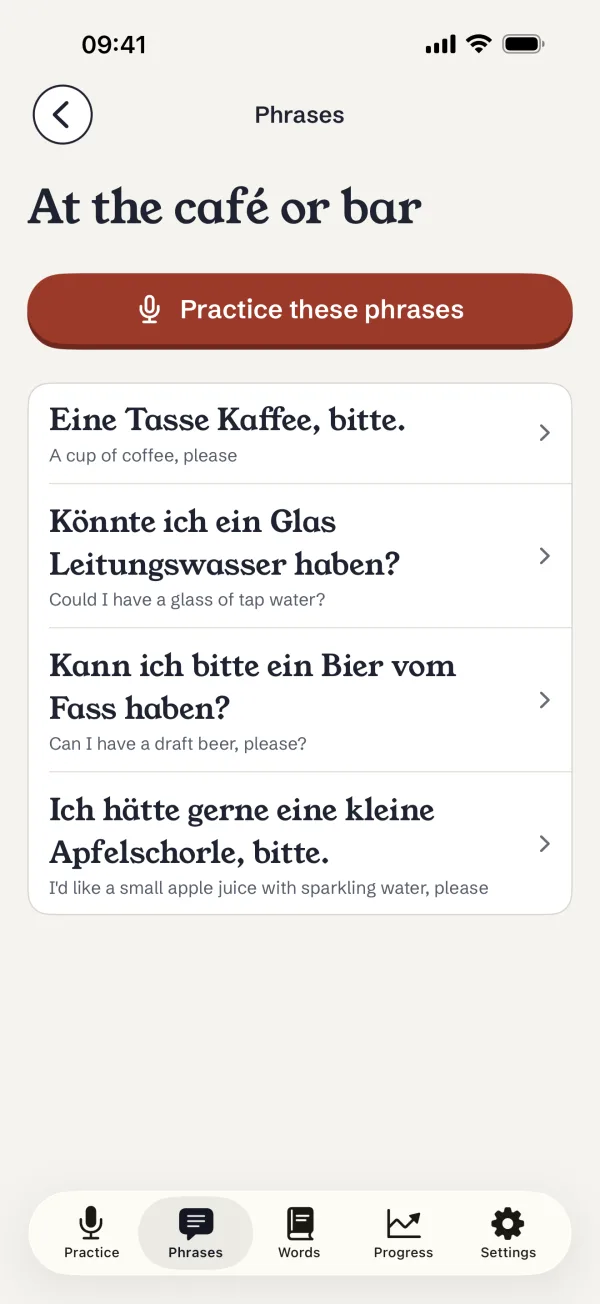
  • The Phrases tab in German, At the café or bar: Eine Tasse Kaffee, bitte. Könnte ich ein Glas Leitungswasser haben? Kann ich bitte ein Bier vom Fass haben? Ich hätte gerne eine kleine Apfelschorle, bitte. Each with its English meaning.

    German phrases at the café or bar.

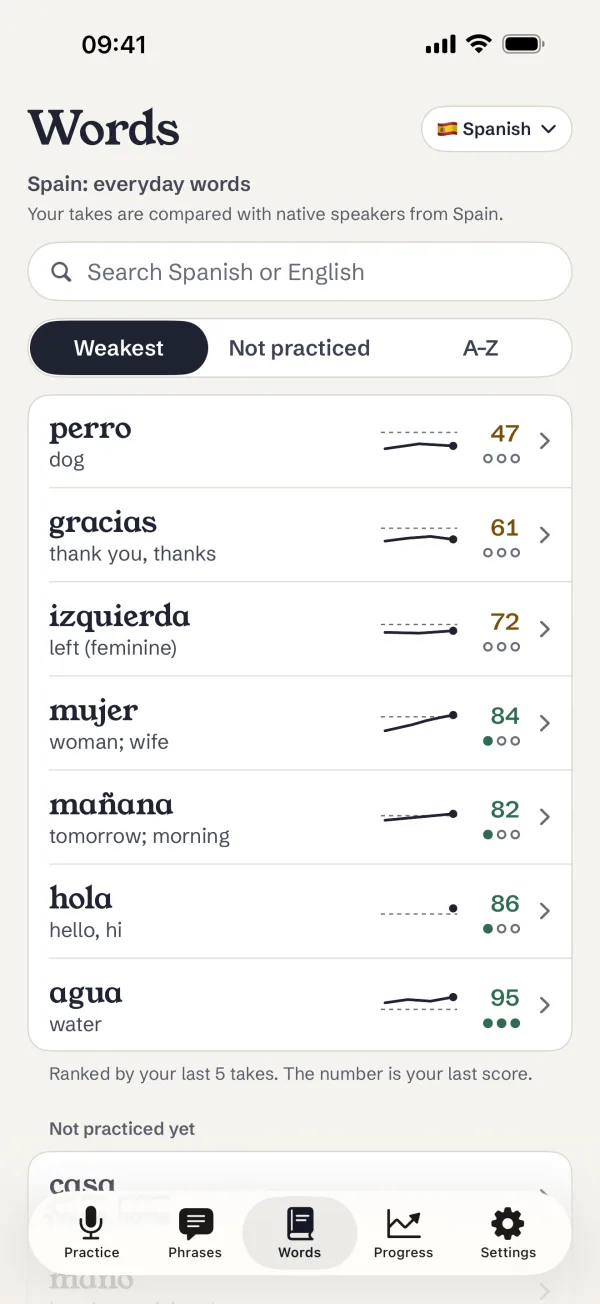
The Words tab for Spanish: Spain, everyday words. A search field, the order Weakest, Not practiced or A to Z, and words with their meaning, a small trend line and the last score: perro 47, gracias 61, izquierda 72, mujer 84, mañana 82, hola 86, agua 95.

Every word, with your score.

Put the weakest words first and practice those.
  • Search in the language or in English.
  • Each word has its own page: your recordings, how the score changed, and the native recordings the app compares yours with.
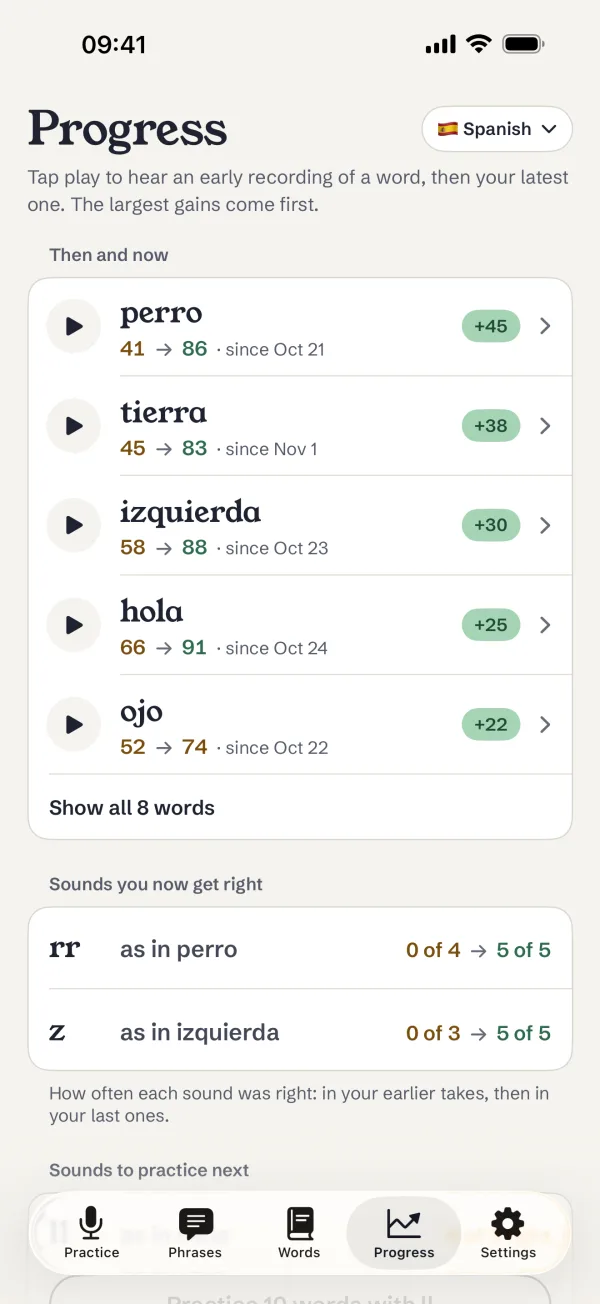
The Progress tab. Then and now: perro 41 to 86 since Oct 21, tierra 45 to 83, izquierda 58 to 88, hola 66 to 91, ojo 52 to 74, each with a play button. Sounds you now get right: rr as in perro, from 0 of 4 to 5 of 5, and z as in izquierda, from 0 of 3 to 5 of 5.

Hear how much you improved.

“Then and now” plays an early recording of a word, then your latest one.
  • The words you improved most are at the top, for example from 41 to 86.
  • Sounds you now get right, and sounds to practice next.
  • One tap starts a round of words with the sound you want to practice.
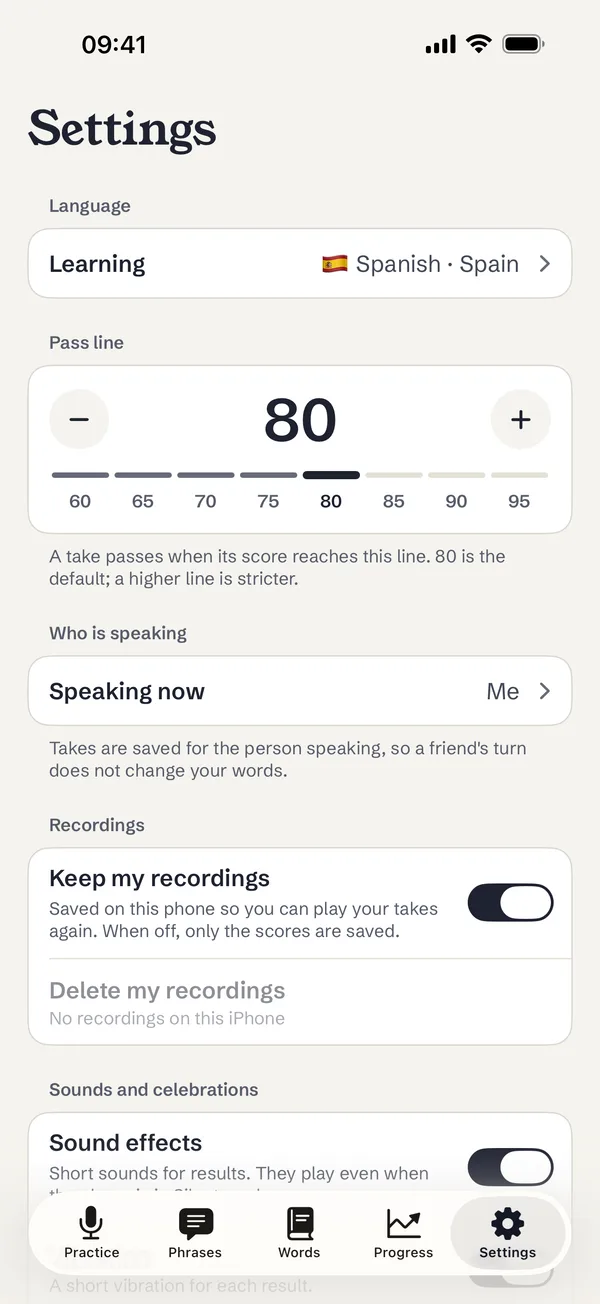
The Settings tab: Learning Spanish, Spain; the pass line at 80 on a scale from 60 to 95; Speaking now: Me; Keep my recordings, switched on.

Choose how strict the scoring is.

A word passes at 80. You can set that score from 60 to 95.

  • “Speaking now” lets a friend take a turn without changing your scores.
  • Choose whether to keep your recordings or only the scores.
  • Sound effects, vibration and celebrations each have their own switch.

Privacy

Shablau never sends your recordings anywhere.

No account, no ads and no tracking. Usage data is sent only if you say yes.

  • Scored on your phone

    After you download a language, the app works offline.

  • Nothing is sent

    The app goes online only to download a language. We never see your recordings or scores.

  • Kept on your phone

    Turn off “Keep my recordings” in Settings to keep only the scores.
App Store · Google Play

Get the app.

Shablau is on the App Store and Google Play. You need an iPhone with iOS 26 or later, or an Android phone with Android 12 or later.


Download on the App StoreGet it on Google Play